

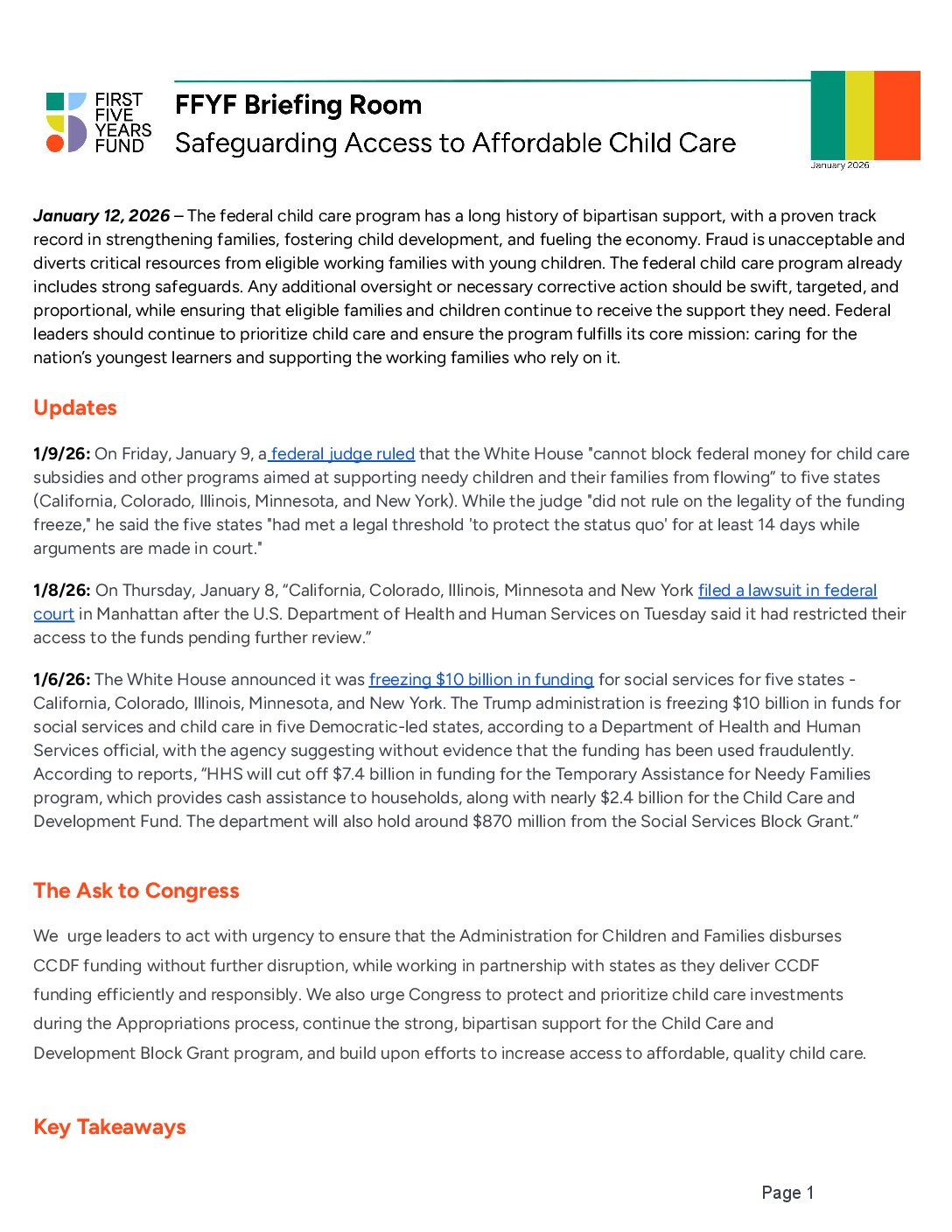
February 3, 2026 – The federal child care program has a long history of bipartisan support, with a proven track record in strengthening families, fostering child development, and fueling the economy. Fraud is unacceptable and diverts critical resources from eligible working families with young children. The federal child care program already includes strong safeguards. Any additional oversight or necessary corrective action should be swift, targeted, and proportional, while ensuring that eligible families and children continue to receive the support they need. Federal leaders should continue to prioritize child care and ensure the program fulfills its core mission: caring for the nation’s youngest learners and supporting the working families who rely on it.
Joint Statement
More than 50 State and National organizations issued a joint statement to emphasize the urgent need to ensure that federal child care resources continue to reach eligible families with young children, while maintaining active oversight and accountability. The statement was submitted for the record in the 1/13/26 Ed & Workforce hearing and shared widely with Members of both parties.
Bottom Line
We urge leaders to act with urgency to ensure that the Administration for Children and Families disburses CCDF funding without further disruption, while working in partnership with states as they deliver CCDF funding efficiently and responsibly. We also urge Congress to protect and prioritize child care investments during the Appropriations process, continue the strong, bipartisan support for the Child Care and Development Block Grant program, and build upon efforts to increase access to affordable, quality child care.
Key Takeaways
Child care is essential for working families with young children.
Strong oversight and accountability are necessary.
Response to problems must be swift, targeted, and proportional.
Situational Background
What’s Happening
2/6/26: A federal judge Friday extended the order that blocks the Administration from freezing funds for child care and other social services in five states (Minnesota, California, Illinois, New York, Colorado). States will continue to receive funding while this lawsuit works its way through the courts.
1/23/26: A federal judge says the Trump administration must keep the money flowing for now for programs aimed at helping low-income families with children in five states.The ruling Friday from U.S. District Judge Broderick extends by two weeks a temporary one issued earlier this month that blocked the federal government from holding back the money from California, Colorado, Illinois, Minnesota and New York.
1/12/26: A federal judge temporarily blocked the Administration from freezing $10 billion in social services funding to five states. There will be a hearing on January 23 to decide next steps.
1/9/26: On Friday, January 9, a federal judge ruled that the White House “cannot block federal money for child care subsidies and other programs aimed at supporting needy children and their families from flowing” to five states (California, Colorado, Illinois, Minnesota, and New York). While the judge “did not rule on the legality of the funding freeze,” he said the five states “had met a legal threshold ‘to protect the status quo’ for at least 14 days while arguments are made in court.”
1/8/26: On Thursday, January 8, “California, Colorado, Illinois, Minnesota and New York filed a lawsuit in federal court in Manhattan after the U.S. Department of Health and Human Services on Tuesday said it had restricted their access to the funds pending further review.”
1/6/26: The White House announced it was freezing $10 billion in funding for social services for five states – California, Colorado, Illinois, Minnesota, and New York. The Trump administration is freezing $10 billion in funds for social services and child care in five Democratic-led states, according to a Department of Health and Human Services official, with the agency suggesting without evidence that the funding has been used fraudulently. According to reports, “HHS will cut off $7.4 billion in funding for the Temporary Assistance for Needy Families program, which provides cash assistance to households, along with nearly $2.4 billion for the Child Care and Development Fund. The department will also hold around $870 million from the Social Services Block Grant.”
Increased Attention On The Hill
Existing Oversight Mechanisms
The design of the CCDF program gives states flexibility and discretion on how they use the funding, which allows them to best meet the needs of their families. This means it is important to have safeguards that protect these programs and ensure our youngest learners have safe, affordable places to receive care while their parents are working.
By law, the following federal and state oversight mechanisms are required:
Current Federal Oversight Mechanisms (HHS / ACF)
Current State Oversight Mechanisms
Original Source: Language from Statutes and Letters
Code on Federal Regulations, with information on eligibility (including income, citizenship status, age, and more).
The text of the lawsuit filed by the five states with the United States District Court for the Southern District of New York.
Details of new HHS requirements:
Support For Federal Child Care – CCDF/CCDBG
Stats: Child Care Is Essential To Families and Young Children
Polling: Federal Child Care Support is Overwhelmingly Popular
Federal support for child care is overwhelmingly popular among Americans, who strongly recognize the need for help making child care more affordable for families with young children.
Links
Print-Friendly Version
link