
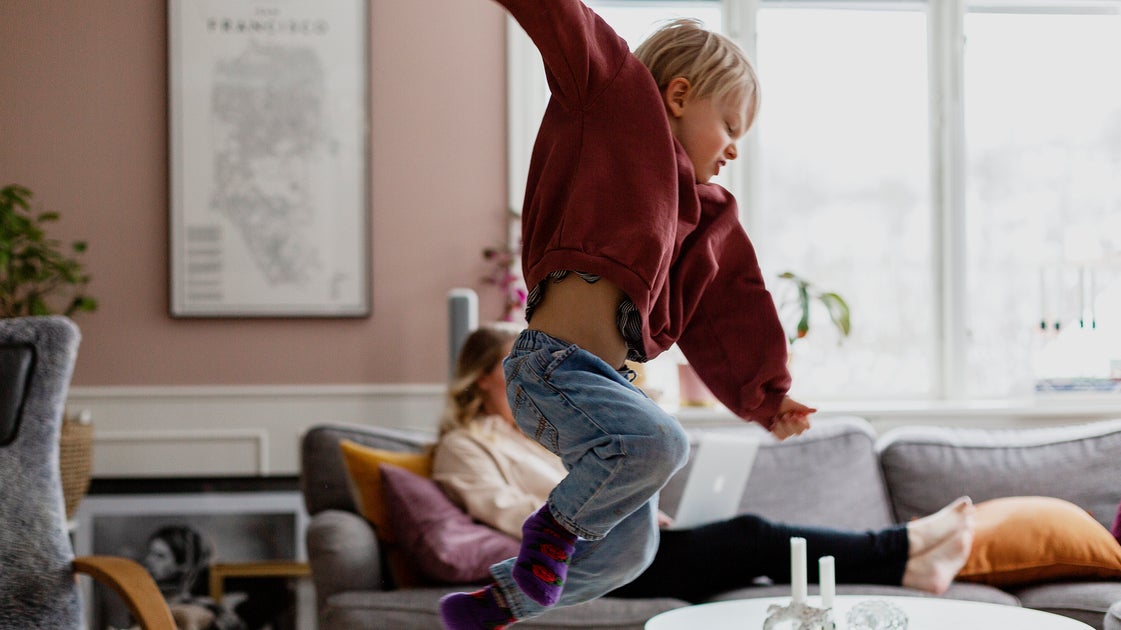
Growing up, clinical psychologist Amber Thornton was undeniably a “bedroom kid.” The living room wasn’t really her terrain but an adult world. She felt far more comfortable feeling her feelings, playing with her toys and doing her homework in her bedroom.
Now a mother herself to a 6-year-old son and a 4-year-old daughter, Thornton’s noticed that both her children are more “living room kids.” In spite of her and her husband’s efforts to create warm communal spaces in their home and turn the basement into a dedicated playroom ― the kids prefer to be wherever mom and dad are.
“I am raising kids who really only go to their bedroom for bedtime,” she said. “That’s because we have developed and cultivated a space where they feel comfortable to express, and be and feel, and that makes me feel good,” Thornton recently said in the clip, which has made the rounds on Instagram this month.
“So if you are also a millennial that you’re raising ‘living room kids’ when you were a bedroom kid, shoutout to you because something’s going right,” Thornton said, before admitting that such a scenario can leave the parents feeling a little overstimulated.
Millennial parents in the comments said they could relate.
“We weren’t even allowed to play, let alone keep toys in the living room,” one mom wrote. “Now my son is Spider Man all over the house.”
“We safe-spaced too hard,” another millennial mom joked.
The “bedroom kid” vs. “living room kids” discussion ― one that has been all over TikTok and Threads for the last year or so ― has become a symbolic way for creators to speak about breaking generational patterns, often for the better, Sarah Spencer Northey, a marriage and family therapist in Washington, D.C., said.
“Plus, I think having ‘living room kids’ may be a practical preference when it comes to monitoring kids for safety online,” Northey told HuffPost.
Still, it takes a lot of emotional labor to have the kids constantly present in the family space, said Northey. (She’s a mom herself of “living room kids.”)
“Sometimes I envy the space ― both physical and emotional ― that ‘bedroom kids’ allow their parents. Maybe I’ll become a ‘bedroom parent,’” she joked.
The ‘living room kid’ versus ‘bedroom kid’ divide could reflect Boomer and millennials’ different parenting styles.
On TikTok, a lot of the creators have taken the conversation about “bedroom kids” versus “living room kid” further, discussing their own considerably different childhood with Boomer parents.
While she says it’s not the whole story, from a clinical standpoint, Thornton said she believes the rise of “living room kids” is tied to how differently millennials and Boomers approach raising kids.
“When I think of Baby Boomers, the one term that really comes to mind with regard to their parenting or that generation of parenting is respectability,” said Thorton, the psychologist, who’s also the author of “A Parent’s Guide to Self-Regulation.”
“I think about respect for authority, and just this general idea of what it means to respect the power differential within a family dynamic,” she explained.
It’s not that this approach was wrong, she said. The priority was simply respect for authority or for parents — but that often came at the expense of a child’s ability or desire to express themselves or ask questions freely. Unless they were counterculture hippy types, most parents weren’t concerned about creating “safe spaces,” either.
Thornton added that the cultural shift toward prioritizing mental and emotional health — along with the explosion of parenting discussions online — may have contributed to the rise of “living room kids” as well.
“What I believe potentially is happening is that as the parenting cycles are shifting to embrace more authentic communication and emotional expression, children aren’t afraid to be reprimanded so strongly for certain things or asking certain questions,” she said. “There’s an increase in comfort.”

PM Images via Getty Images
Northey considers generational differences in parenting as part of this conversation, too.
To speak in generalizations about generations, some Boomers leaned on harsher parenting methods — approaches that produced quick compliance and no backtalk, while aiming to prepare kids for a tough world.
“Unfortunately, we are seeing the latent consequences of that parenting style,” Northey said. “Many Boomer parents have the rude awakening that their children have significant struggles with their mental health as adults.”
Reflecting the harshness and distance with which they were raised, some millennials simply want to do things differently.
The conversation leaves out a few key things like how personality styles influence play preferences.
There’s some nuance missing from conversations on TikTok and Instagram about all this, though, said Lauren Maher, a marriage and family therapist in Los Angeles who works with creatives and highly sensitive people.
Maybe it’s her Gen X nature, she joked, but as a former “bedroom kid,” she felt the need to explore a totally different angle in this conversation.
“It strikes me that the framing of this is a bit of a false dichotomy,” she told HuffPost. “There are so many reasons why a child may crave time alone, and it may not be because they don’t feel safe in their household.”
Studies have shown that American culture generally tends to prioritize extraversion as a virtue. But children, just like adults, can also be introverted, and we want to be careful not to pathologize this quality, Maher said.
“Many introverts are creative, sensitive, deep thinkers,” she said, “and can feel drained by social interaction or the presence of others, but renewed and recharged by alone time.”

AleksandarNakic via Getty Images
She noted that highly sensitive or neurodivergent children can become overstimulated and may value time alone to unwind or process information, and creative or artistic children often like to spend time listening to music, engaging in solo creative projects or simply letting their minds wander.
“You could argue that it’s also a sign of great parenting if a child feels comfortable enough to spend some time alone and safely explore their own inner world,” she said.
“Personally, some of my most precious childhood memories are of time spent endlessly reading books, drawing and letting my imagination run wild in my bedroom — and no doubt I felt the comfort to do that because I felt the safe presence of my mom or dad nearby,” Maher said.
It really can come down to the personality of the kid. Abigail Gewirtz, a professor of psychology at Arizona State University and the author of “When the World Feels Like a Scary Place: Essential Conversations for Anxious Parents and Worried Children,” said her kids aren’t strictly “bedroom” or “living room kids,” though her oldest daughter was a “bedroom kid” through-and-through. Not so for the younger kids.

“They loved doing their homework at the kitchen table, with their snacks and my husband and me around,” she said.
The atmosphere of the home or its physical layout may influence how kids prefer to play, too, Gewirtz said.
Then there’s how available parents make themselves to their kids and values around togetherness and individuality or independence, which can differ across cultures.
So at the end of the day, both “living room” and “bedroom kids” can be healthy.
“As a parenting researcher I am all in for helping parents reflect on and improve their parenting when indicated, but I want to emphasize that we should not use this idea as yet another stick to beat parents with,” she said.
Wherever kids find the space to help them feel competent and practice skills in development is great, she said, “whether it’s the living room, the bedroom, or at grandma’s house.” (Here comes the “grandma’s house kids” discourse on TikTok.)
link