

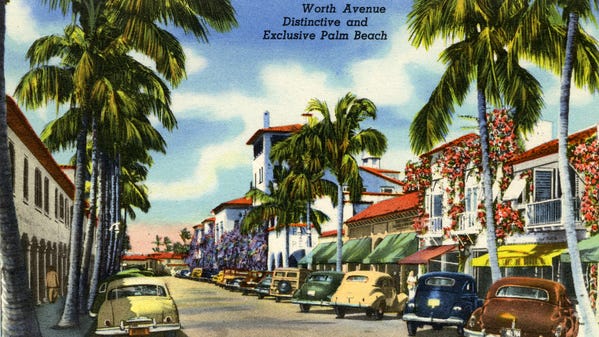

Video: Colorful postcards show Palm Beach in its early years
Postcards from the State Archives of Florida show the island, its people and landmarks, including The Breakers, Mar-a-Lago and Whitehall.
Palm Beach’s Henry Morrison Flagler Museum added another award to its mantle, after the Florida Trust for Historic Preservation honored the restoration of the historic mansion’s dining hall.
During a July 17 award ceremony, the nonprofit dedicated to protecting Florida’s heritage and history chose the Flagler Museum, also known as Whitehall, as one of the winners of its 2025 Florda Preservation Award in the category of Restoration, Rehabilitation or Adaptive Use, according to a Florida Trust for Historic Preservation release.
“The restoration of the Whitehall Dining Room is a significant achievement for the Museum, and we are proud to receive the Florida Trust’s 2025 Preservation Award,” Flagler Museum Executive Director and CEO Amanda Skier said in a statement. “This recognition, and the restoration itself, underscores the Museum’s mission to authentically preserve and interpret Whitehall and Henry Flagler’s legacy — ensuring that this Gilded Age masterpiece continues to educate and inspire future generations.”
The mansion was built by Standard Oil co-founder and hotel-and-railroad magnate Henry Flagler in 1902 for his third wife, Mary Lily Kenan Flagler.
The dining hall takes its design influence from the Henry IV style. Woodwork details each of the hall’s walls, the most notable example of which is the wooden fireplace with its unusual hand-carved floral and aquatic motifs.
For years, museum officials had been unaware that the room’s wood detailing was made of West Indian satinwood, a species that has not been sold commercially for decades due to overharvesting and habitat loss. The wood is coveted for its honey-color and striped grain pattern.
That discovery came in 2018, after a yearlong effort led by Virginia-based F. Carey Howlett & Associates to find the hall’s historic dining table set. F. Carey Howlett told the Daily News in August 2024 that a dark tint had been applied to the dining set that completely masked the wood’s features.
“It was so black you couldn’t really tell what kind of wood it was,” Howlett said at the time.
After Howlett used solvents to carefully dissolve portions of the tint, he made the stunning discovery that the set was made of West Indian satinwood.
But that led to another inquiry, as archival photographs of the dining hall showed the room’s original wooden detailing had the same light wood tone as the dining furniture’s finish.
After further testing, conservationists confirmed that nearly all the wood detailing the dining hall was indeed West Indian satinwood.
During the middle of repairs, museum officials also discovered an article that highlighted that the coffered ceiling’s insets were green. Before the renovation, they were beige with faux-gilt accents.
The dining hall is just one of the three West Indian satinwood rooms in the United States. The other two are the Worsham-Rockefeller Bedroom, currently housed at the Virginia Museum of Fine Art, and the Worsham-Rockefeller Dressing Room, which is on view at New York’s Metropolitan Museum of Art.
The Henry Flagler Morrison Museum, 1 Whitehall Way, is open from 10 a.m. to 5 p.m., Tuesday through Saturday. For more information visit www.flaglermuseum.us.
Diego Diaz Lasa is a journalist at the Palm Beach Daily News, part of the USA TODAY Florida Network. You can reach him at [email protected].
link