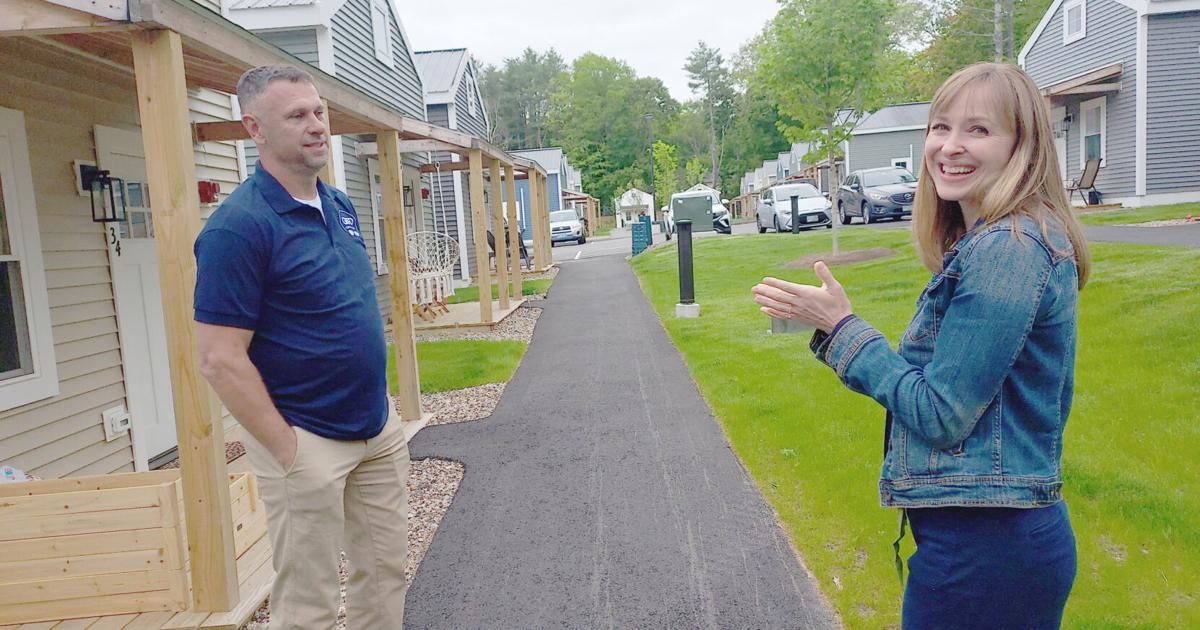
Meg Farley’s 384-square-foot house is not an outbuilding, a camp or a compromise. It’s an oasis.
Nestled in the Cottages at Back River Road on Uncommon Drive in Dover among 44 nearly identical dwellings, Farley’s tiny home features a living room with a 12- to 16-foot ceiling, a bathroom with a shower, a downstairs bedroom she uses as an office, a galley kitchen, a front porch facing a green, and a loft with another 160 square feet, big enough for a queen-size bed and two bureaus.
For the 65-year-old high school librarian, it’s a palace in miniature, a right-size home that matches her needs, lifestyle, income — and her desire to live in a community with open space and neighbors who know one another.
“It’s hard to believe that such a little slice of heaven would be here,” said Farley, seated on her living room couch looking out at a woodsy view. She moved to the Cottages after living in a three-story home with her family, dogs and a garden, followed by two apartments in Portsmouth.
Meg Farley, a high school librarian, sits in the living room of her new home in the Cottages at Back River Road in Dover.
Welcome to tiny homes, a lifestyle choice and an affordable option for a stand-alone privacy where the cost of renting or buying a home has rocketed beyond the reach of average earners.
Homes like Farley’s could also be a strategic piece in New Hampshire’s housing puzzle, a way to provide single-family homes for the “missing middle” — working people and retirees whose incomes, pensions and savings are dwarfed by rising home prices and rents.
Will acceptance outshine resistance in communities that talk about the need for affordable housing? How about towns that are skeptical of tiny homes? Will necessity become the mother of innovation and allow compact to become a new normal?
In New Hampshire, 90,000 more housing units are predicted to be needed by 2040, approximately 8,000 more each year, according to estimates used by the New Hampshire Housing Finance Authority.
The American Tiny House Association promotes tiny homes as a “sustainable, affordable option supporting a lifestyle of simplicity and self-reliance” with a creative use of space.
The 1,022-member Tiny Home Industry Association, launched in 2016 and active in the U.S., Mexico and Canada, has promoted international standards and helped to pass 35 laws supporting tiny homes. Dan Fitzpatrick, the trade organization’s president, estimates that there are 10,000 to 12,000 tiny homes currently in place across the United States.
The biggest tiny-home buyers nationally are people ages 55 and older, but the demographic is widening. “So many millennials and Gen Z’s can’t afford a house,” Fitzpatrick said.
“We’ve heard that younger Granite Staters want more options, including tiny homes,” said Nick Taylor, executive director of Housing Action NH. Going small “gives them the flexibility to work, live and travel without the responsibility” to maintain a larger place.
Tiny homes can also be a solution for empty nesters wishing to downsize or stay in their larger house while renting their backyard tiny home to children, grandchildren or a caregiver who can live on-site and help them.
National housing statistics based on U.S. Census and Department of Housing and Urban Development data show that approximately one-third of U.S. households comprise one person and 70% are two or fewer people, including single parents.
Tiny homes are becoming more common in Florida, Texas, Washington, Oregon and California, with expansion concentrated on the coasts.
They’ve been a harder sell in New Hampshire towns that are reluctant to embrace them for reasons ranging from not wanting a development that might look like a mobile home park (a cluster of summer cottages is a better comparison) to fears of decreasing neighboring property values and not being able to collect enough property taxes from dwellings that are smaller and assessed for less than the average house.
Apartment alternative
Evan Clough, 33, an oyster farmer and construction worker, and his wife, Brit, 31, who works in a physical therapy office, moved to the Cottages at Back River Road in September. They had lived in Portsmouth for four or five years in a two-bedroom apartment with a basement, a garage and a roommate who helped pay the rent.
“We were in dire need of an apartment,” said Clough. “It’s a pretty big change. We don’t have a couch. We don’t want a couch. We have two comfy chairs” in a living/dining area with a screen to watch movies and play video games.
“Cabinet-wise, it has space for all our kitchen needs.”
Evan Clough and his wife moved to the Cottages at Back River Road in September from a two-bedroom apartment in Portsmouth that they shared with a roommate.
ROBERTA BAKER/UNION LEADER
In the loft upstairs, a queen-size bed sits on a platform with drawers underneath.
Their ground-floor spare room houses their fishing rods, skis, snowboards, skateboards, motorcycle helmets and Clough’s electric keyboard. A beanbag chair unzips to become a mattress for overnight guests. A nook designed for a washer-dryer is used for storage. The couple washes their clothes at a Dover laundromat or at Clough’s parents’ house.
“This is the first time my wife and I have lived alone,” he said. “It’s nice to live here, be able to afford it, and enjoy each other’s company.” Their highest combined utility bill for heat, hot water and electricity was $140 in February, he added.
“If you can save a little money while you’re here,” owning your own home can happen sooner. he said. “If a house isn’t in our future, we can be happy here.”
The workforce factor
At $1,517 a month to rent, the 16-by-24-foot Cottages at Back River are affordable, especially for standalone living.
“It’s really petite and cozy. Not too small,” said Farley.
Her work desk doubles as a dining room table for guests. “I’ve had birthday parties in here with six or seven adults. They bring their soccer chairs and boom, here we are. Fifteen minutes to clean the entire house.”
According to proponents, they’re a viable option for workforce housing — not just senior housing.
Maggie and John Randolph, a husband-and-wife team, were inspired to create the Cottages at Back River Road to help their employees at two assisted-living facilities.
“We kept hearing from our employees that they couldn’t afford to live on the Seacoast. They were commuting an hour each way. It was turning an eight-hour day into a 10-hour workday,” said John Randolph, an Air Force veteran who owns and operates Harmony Homes Assisted Living in Dover.
“We were also trying to keep things affordable for seniors. Raising prices isn’t the way to do it.”
A lot of adults over 55 and singles 18 to 25 “are looking for the same thing,” Randolph said: “an ability to downsize and have less maintenance and cleaning time.”
The Randolphs built the Cottages in phases starting in 2022. The latest resident moved in last December.
They laid the groundwork before any site work. They went door to door to answer abutters’ questions.
There was little or no resistance to the appearance of the cottage cluster or its density, but neighbors were concerned about traffic and screening, according to Chris Parker, Dover’s deputy city manager.
A traffic study showed less impact than anticipated. A fence was put up at neighbors’ request. The Randolphs painted the houses to match colors in adjacent subdivisions.
Dover created cottage zoning to allow the tiny home neighborhood. In exchange for keeping the rent low, the city permitted a higher concentration of dwellings (44 on 3.5 acres with 3.5 acres of surrounding woods) on land that would otherwise support nine houses.
“Fear of the unknown can be a concern,” said Parker. “Like a lot of things, if you don’t know it, it can be an intimidating or scary idea. But once you experience it, you better understand and appreciate the benefits.”
Meg Farley looks down from the 160-square-foot sleeping loft of her home in the Cottages at Back River Road in Dover. The 384-square-foot main floor includes a living room, a three-quarter bath, a galley kitchen and a spare room Farley uses as an office.
ROBERTA BAKER/UNION LEADER
Building community
“Once you personalize the people who are living there —teachers, firefighters, health care workers — it becomes less of an unknown,” said Maggie Randolph, the architect who designed the tiny homes. “People say, ‘I’m OK living next to a nurse.’”
The current residents, ages 19 to 73, include nine teachers, two firefighters, and an assortment of tradespeople, health care workers and single parents with ties to the Seacoast who are priced out of the larger housing market.
Children play on the green between the homes. The residents “have their own front door and nobody above or below them,” wwhich helps with privacy and noise control, John Randolph said.
The goal was to make housing for people earning $50,000 to $60,000 a year, roughly 60% of Dover’s median household income. The 44-home project is assessed at $3.9 million, said Parker. Nine full-size single-family homes would be almost double that, he said.
In Dover, “We want to be welcoming and say, ‘Come in, move in and stick around regardless of your income or family status,’” Parker said. “Demographically we recognize that people want smaller homes and more opportunities” for living close to where they work, relax, and have family and friends.
“This was helping us reach an underserved residential population,” Parker said. “The Cottages “had a waiting list the day they opened and they still do.”
‘Cusp of a revolution’
The Cottages at Back River Road have attracted interest. A group of New Hampshire mayors toured in April. The Randolphs said housing advocates have come to visit or contacted them from around the U.S. and from countries including Spain, Switzerland, the Netherlands and Australia.
“It gives people a sense of autonomy, a sense of the space being yours even though it’s rented,” said Maggie Randolph, standing between two cottage homes that sit 12 feet apart. “The thing I’m most proud of, it’s the people who live here. A lot of people who reach out are making good money but can’t find a place they can afford in New Hampshire.”
“I’ve said to (the Randolphs), I think you’re on the cusp of a revolution in housing,” said Farley, standing outside her front porch and contemplating a flower box with plantings that arrive in a kit. “Gone are the McMansions now.
“I think it’s the answer to housing problems. Give people what they need,” she said. “Make it affordable. … I would love to see these proliferate. It’s a meaningful solution.”