


Welcome to How They Pulled It Off, where we take a close look at one particularly challenging aspect of a home design and get the nitty-gritty details about how it became a reality.
There are 5,610 single-story structures, colloquially called “earthquake shacks,” that dot San Francisco. Built after the 1906 earthquake wiped out 500 city blocks, these buildings were initially constructed as temporary housing for over 17,000 residents. Each wooden cottage was around 200 square feet with a dark-green exterior, tiny but just big enough for a family to use as shelter. The exact number of remaining shacks is unclear; however, the location of one very particular earthquake shack is known: it’s at the back of San Francisco, Lisbon, and Kingston, New York-based Síol Studios’ latest project.


The owners loved the original untouched exterior, but were eager to change most of the interior both to suit their lifestyle and aesthetic.
From the outside, the main house, behind which the shack sits, looked like one of the city’s many typical architectural jewels: an Eastlake Victorian from 1885 in near-pristine condition. However, the exterior masked decades of multiple hodgepodge interior renovations. “Each [renovation] was painful in some respect,” says Síol Studios cofounder and principal Kevin Hackett. “The flow was lost.” When he and the team started work, the interior was dark and tight with a chaotic layout. But it had one upside: the earthquake shack in the back, once used as a lackluster dining room and now ripe for revitalization.


In the entry, a bench from Mary Ratcliffe Studio sets the tone for the airy interiors.

The primary bedroom features the floor-to-ceiling drapes that are a staple throughout the new renovation, highlighting the home’s tall ceilings.
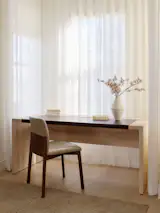
A desk from Croft House and a chair from Design Within Reach complement whitewashed oak floors.
The overall renovation, which encompasses architecture, interior design, and landscape design, restores the spirit of the house—incorporating the facade’s elongated patterning and arched shapes into the new architectural language—while creating a contemporary space that reflects how the owners actually live now. Equally important was restoring the garden and visually reconnecting it to the interior. That same approach is applied to the reimagined dining room, which still occupies the earthquake shack, but this time lighter, airier, and connected with the revitalized garden, and which still preserves a lesser-known piece of Bay Area history.

The primary bathroom features a soaking tub, stone slab flooring, and tile from Heath Ceramics.
How they pulled it off: An existing earthquake shack becomes an airy dining room
- Rather than layering a contemporary design over the Victorian house, Síol Studios’ design emphasized carefully informed, subtle interventions. “We spend a lot of time in due diligence, and extract three or four key things that will resonate from the outside to the inside to the outside again,” says Hackett. In this case, that included research into the history of earthquake shacks and building on their knowledge of classic San Francisco homes.
-
Central to the renovation was bringing the backyard to life—something made possible, in part, through a stronger connection through the dining room. “Instead of this appendage, which it felt like when we were first there, like something that was really just stuck on, it became about creating a portal for bringing the garden in and engaging into the main space,” says Hackett. The shack’s new sliding glass door opens onto a newly built deck with space for dining and stairs leading down to the garden level.
-
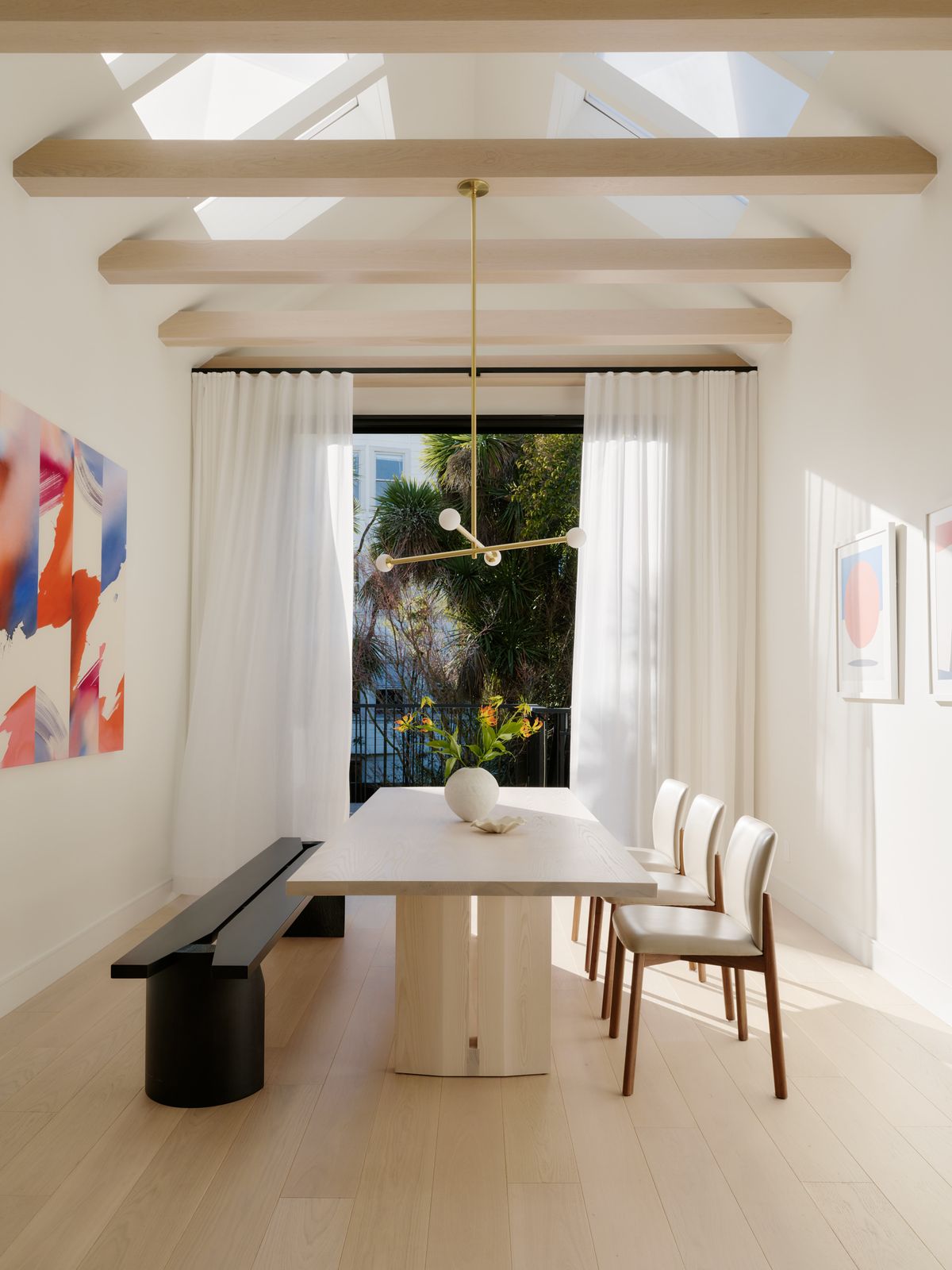
“We did a lot of structural work around the shack, opening up the glazing and walls to bring in as much light as possible,” says Hackett. The threshold between the earthquake shack and the kitchen was opened up by three feet on either side, creating more fluid circulation within the house, and the ceiling height was raised by four feet. The garden-facing sliding glass door was also expanded, strengthening the connection between the backyard garden and the interior. “It became this beautiful cathedral of afternoon light that pours into the kitchen,” says Hackett.
-
The structural collar ties, which are horizontal beams that resemble ceiling rafters, had been bulked up. Síol Studios stripped them back to expose the original elements and clad them in a light oak.
-
“The owners wanted a house full of books and music and art from their travels,” says Síol Studios cofounder and principal Jessica Weigley. “We had a light touch when it came to the furniture. We didn’t want to overpopulate the home because they wanted to continue adding to it.” The furnishings they did add were selected to emphasize the architectural details—like the floor-to-ceiling drapes in the earthquake-shack-cum-dining-room, which highlight the tall ceilings.
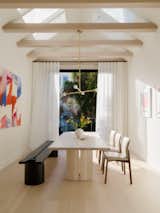
The six existing skylights were preserved. Although not an OG earthquake shack feature, they were a rare, welcome addition from a past renovation. A brass pendant from Allied Makers is suspended above a bleached ash dining table. In the background, the backyard beckons through the enlarged glazing.
“When we see buildings that have undergone all these different remodels, what’s most important to us is that we come at the design with extraction, not addition,” says Hackett. It’s in the spirit that the residence is both restored and revived for its next chapter.
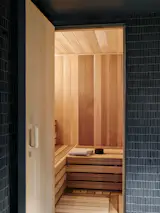
Design decisions reinforced that connection to the landscape, whether that was the thoughtful program—the basement, given its limited access to natural light, is a wellness floor with a sauna and cold plunge, while the light-filled living spaces are on the upper levels—or expanding the glazing in the shack-turned-dining room.

The existing shack felt dark and experientially disconnected from the remaining house, and although the backyard hadn’t been cared for in years, the new owners loved that the house had potential for an idyllic outdoor space.

For Síol Studios, which is an integrated practice with a holistic approach to architecture, interior design, and landscape designs, the renovation was also a chance to restore the garden, creating a landscaped oasis with a sunken firepit visible from the revived dining room.
Cabinetry Design: iDo Cabinetry
Kitchen Wood Countertops and Trim Work: J.W. Sellars Furniture
link